Quality Inspection Services
Final Random Inspection (FRI) & Pre-Shipment Inspection China | G&D
Independent Final Random Inspection (FRI) and Pre-Shipment Inspection (PSI) services in China. Our inspectors check finished products before shipment, including workmanship, quantity, specifications, measurements, function, labeling and packaging, using AQL random sampling where applicable. Receive an independent inspection report with photos and findings to help you identify quality issues before shipment. Inspection service starts from USD 160 per man-day.
Final Random Inspection (FRI) / Pre-Shipment Inspection in China
Verify your finished goods before they leave the factory.
A Final Random Inspection (FRI), commonly used as a Pre-Shipment Inspection (PSI), checks finished goods when production is 100% completed and at least 80% of the goods are packed into boxes, allowing representative random sampling from the finished shipment.
Our inspector visits the factory, randomly selects samples from the available shipment, and checks them against your confirmed requirements. Depending on the product and agreed scope, this may include workmanship, dimensions, function, quantity, labeling, accessories and packaging.
You receive an independent inspection report with findings, photos, test results and defect details to support your shipment decision.
When Should You Arrange a Final Random Inspection?
FRI is normally arranged when production is 100% completed and at least 80% of the goods are packed into boxes, so that representative random sampling can be carried out.
It can be particularly useful when:
- You are working with a new supplier.
- The order has important appearance, measurement, function or packaging requirements.
- You want to verify the finished goods before shipment.
- You need independent information before releasing the remaining payment.
- Previous orders have had quality or packaging problems.
- The products are customized or sensitive to customer complaints.
If the main risk needs to be checked while production is still running, a During Production Check (DPC) may be more appropriate.
What We Check During a Pre-Shipment Inspection
The inspection scope is prepared according to your product and confirmed requirements. Typical checks include:
Workmanship & Appearance
Visible defects, finishing, color, stitching, printing, assembly and other product-specific workmanship.
Quantity & Assortment
Available quantity, packed quantity, model, color, size and SKU distribution where applicable.
Dimensions & Specifications
Key measurements, weight and other specifications according to the information you provide.
Function & On-Site Tests
Basic functional checks and agreed product-specific tests that can reasonably be performed under factory conditions. Depending on the product, this may include assembly checks, operation tests, fit checks, basic safety checks or other agreed procedures using available equipment.
Labels & Accessories
Product labels, barcodes, instructions, accessories, markings and other required components.
Packaging
Retail packaging, inner packing, export cartons, carton markings and packing configuration.
Defect Classification & AQL Sampling
Samples are randomly selected according to the agreed sampling plan. Identified defects are recorded and classified according to the agreed defect criteria.
How Does AQL Sampling Work?
FRI normally uses random sampling rather than checking every unit in the shipment. The sample quantity depends on the lot size, inspection level and agreed sampling plan.
The selected samples are checked and identified defects are classified according to the agreed criteria. The results are then compared with the applicable acceptance and rejection limits.
What Information Should You Provide Before the Inspection?
The more clearly your requirements are defined before the inspection, the more effectively the inspector can check the shipment against your expectations.
Depending on the product, useful information may include:
- Purchase order and order quantity
- Product specifications or technical drawings
- Approved sample or reference photos
- Size, color and assortment breakdown
- Packaging and carton requirements
- Labels, barcodes, shipping marks and artwork
- Required accessories, manuals and inserts
- Product-specific functional or on-site test requirements
- Your own inspection checklist or known quality concerns
If no detailed inspection checklist is available, we can review the information you have and confirm a practical inspection scope before the visit.
How Our Final Random Inspection Works
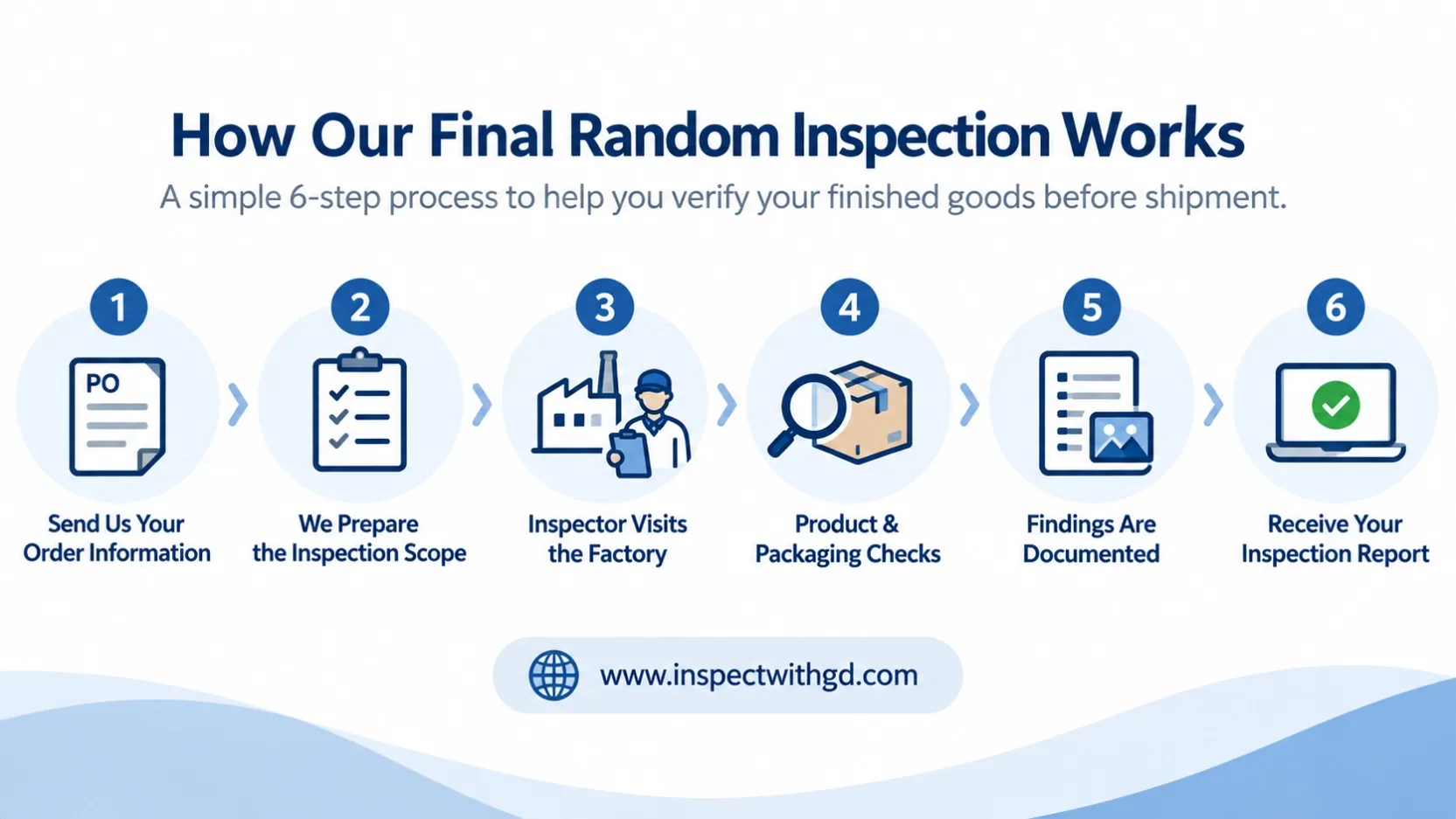
1. Send Us Your Order Information
Share your PO, product specifications, quantity, factory details, packaging requirements and any approved samples, photos or inspection checklist.
2. We Prepare the Inspection Scope
We review your requirements, confirm the inspection date and define the sampling and checking scope.
3. Inspector Visits the Factory
The inspector confirms production and packing status and randomly selects samples from the available shipment.
4. Product & Packaging Checks
The selected samples are checked according to the agreed requirements, including applicable measurements, workmanship, function, labeling and packaging checks.
5. Findings Are Documented
Defects, measurements, test results, packaging observations and relevant limitations are recorded with photographic evidence.
6. Receive Your Inspection Report
Our standard target is to issue the report within 24 hours after the inspection, allowing you to review the actual findings before deciding the next step.
What Happens If Problems Are Found?
Finding a problem during an FRI does not automatically mean that the entire shipment must be rejected.
The report shows what was actually found during the inspection, including defect quantities, defect types, measurements, test results, packaging issues and photographic evidence. You can then review the findings against your own requirements and commercial risk.
Depending on the issue, the next step may include asking the factory to sort or rework the goods, replacing defective units, correcting packaging or labeling, or investigating the cause of a specific problem.
If corrective action is taken, a re-inspection can be arranged when independent verification of the reworked goods is required.
The final decision to accept, rework, re-inspect, hold or ship the order remains with the buyer.
What Will You Receive in the Inspection Report?
Your report includes:
- Order and inspection information
- Production and packing status
- Sampling information
- Inspection findings
- Defect descriptions and quantities
- Product and defect photos
- Measurements and applicable on-site test results
- Packaging and labeling findings
- Inspection result based on the agreed criteria
- Relevant remarks or limitations
The report provides independent evidence for your review. The final decision to accept, rework, hold or ship the goods remains with you as the buyer.
What Can and Cannot Be Verified During an FRI?
A Final Random Inspection provides an independent assessment of the finished shipment based on randomly selected samples and the checks that can reasonably be performed at the inspection location.
It is important to understand that FRI is not the same as checking every unit in the order. Unless a 100% inspection is specifically arranged, the inspection result is based on statistical sampling.
Some product characteristics also cannot be fully verified through normal on-site inspection. Laboratory testing may be required for chemical composition, material performance, certification-related testing or other tests requiring specialized equipment. In such cases, Lab Testing Assistance can be arranged separately.
FRI also takes place near the end of production. If your main concern is controlling materials, workmanship or production problems before the entire order is finished, an earlier inspection such as IPC or DPC may be more appropriate.
The right inspection stage therefore depends on the product, supplier history and the risks you want to control.
FRI or During Production Check?
Choose DPC when you need to identify problems while production is still running and correction is easier.
Choose FRI when you need to verify finished goods before shipment.
For higher-risk orders, the two inspections can also be used at different production stages.
For a concise comparison, see During Production Check vs Final Random Inspection: Which One Do You Need?
Final Random Inspection Cost in China
Starting from USD 160 per man-day.
A typical inspection can often be completed within one man-day, depending on the product, order quantity, number of SKUs, inspection scope and factory location.
Additional man-days or travel costs may apply when the inspection requires more time or the factory is located far from our inspector coverage.
Send us your product information and factory location, and we will confirm the cost before booking.
Frequently Asked Questions
What is a Final Random Inspection (FRI)?
A Final Random Inspection is a finished-goods inspection using random sampling to evaluate the available shipment against confirmed requirements before shipment.
Is FRI the same as Pre-Shipment Inspection?
FRI is a common type of Pre-Shipment Inspection (PSI). It is carried out near the end of production, typically when production is 100% completed and at least 80% of the goods are packed into boxes.
When should FRI be performed?
Normally when production is 100% completed and at least 80% of the goods are packed into boxes, allowing representative random sampling from the finished shipment.
Does FRI inspect every product?
No. FRI normally uses random sampling. The sample size depends on the agreed sampling plan, lot size and inspection level.
How long does an FRI take?
Many inspections can be completed within one man-day, although complex products, large SKU ranges or larger inspection scopes may require additional time.
How quickly will I receive the report?
Our standard target is to issue the report within 24 hours after the inspection is completed.
Need a Final Random Inspection in China?
Send us your product details, order quantity, factory location and expected inspection date. We will review the requirements and confirm the inspection scope, timing and cost before booking.
Starting from USD 160/man-day.