Aug 13, 2026Importing Tips & Best Practices
Factory Audit vs Product Inspection: Which One Do You Need?
Understand the difference between factory audit and product inspection, when to use each service, and how to reduce sourcing risks when working with suppliers in China.
Factory Audit vs Product Inspection: Which One Do You Need?
You found a new supplier in China and want independent information before committing more money and time. The first question is what needs to be verified: the supplier's ability to support the order, or the condition of the products made for you.
A factory audit and a product inspection answer those two questions at different stages. An audit looks at the manufacturing site, resources, processes, and quality controls. A product inspection looks at actual goods from a specific order and compares them with your confirmed requirements.
Neither method is a substitute for the other. The useful choice depends on what you still need to know before making the next sourcing decision.
The Main Difference Between Factory Audit and Product Inspection
The simplest distinction is the subject of the verification: a factory audit evaluates the supplier and its operating conditions, while a product inspection evaluates the goods from your order.
| Factory Audit | Product Inspection |
|---|---|---|
Main question | Can this supplier support my order? | Do these products meet my requirements? |
Typical timing | Before cooperation or early in the relationship | During production or before shipment |
Main focus | Factory capability and management | Quality of a specific order |
Typical result | Supplier evaluation and audit findings | Product findings and inspection report |
Both are point-in-time checks. An audit provides evidence about the supplier on the audit date; an inspection provides evidence about the goods available and sampled on the inspection date.
What a Factory Audit Actually Checks
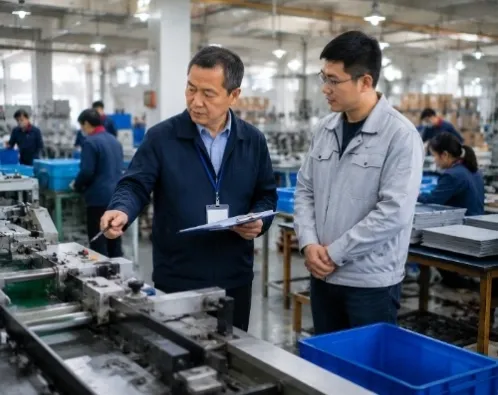
A factory audit begins by confirming the company and manufacturing location being evaluated. The auditor reviews business information, production areas, the main processes carried out on site, and whether the facility shown matches the supplier information provided before the visit.
The visit then follows the production flow. The auditor checks relevant machinery, available production lines, worker organization, current workload, and experience with similar products. The aim is to understand whether the factory has the equipment and practical capacity required for your type and volume of order.
Quality controls are reviewed as part of the same system. This may include incoming-material checks, in-process controls, final checks, handling of nonconforming goods, inspection records, measuring equipment, and how approved requirements reach production staff.
Warehouse conditions provide another useful signal. Material identification, storage, separation of accepted and rejected goods, and traceability between materials and production batches show how the factory manages products beyond the assembly line.
A Factory Audit Service brings these findings together so you can evaluate capability and management before relying on the supplier for production. It does not guarantee the outcome of a future shipment.
When a Factory Audit Is the More Useful First Step
An audit is most useful when supplier capability is still uncertain. This often applies before a large first order, before paying for tooling, when developing a customized product, or when you expect a long-term production relationship.
It is also useful when the information available does not show who actually manufactures the goods. An on-site visit can clarify whether the location has the stated processes, which activities are subcontracted, and whether the available capacity matches the planned order.
The audit scope should reflect your product. A general facility review may confirm that a factory exists, but equipment, process control, and experience relevant to your product are what make the findings useful for supplier selection.
If distance makes the supplier's day-to-day operation difficult to see, What Happens Inside a Factory When You Are Not There? explains why independent visibility matters during production as well as before cooperation.
What Product Inspection Checks
Product inspection starts with a specific order. Random samples are selected from the goods available at the factory and compared with your purchase order, specifications, approved references, packaging instructions, and agreed acceptance criteria.
The checks depend on the product. They may cover appearance, workmanship, measurements, assembly, basic function, labels, accessories, quantity, and packaging. The report should state what was checked, what was found, and which part of the shipment the result represents.
A Final Random Inspection (FRI) is commonly used when production is finished and most goods are packed. Its purpose is to give you independent information about the shipment before it leaves China.
Factory QC and independent verification have different roles. Why Supplier QC Is Not the Same as Buyer-Side Inspection explains that difference without treating the two functions as competitors.
When Product Inspection Should Be Scheduled
Arrange product inspection when the main question concerns the goods being produced for you. This is especially relevant for a first production order, customized items, products with strict dimensions or functions, and shipments where customer acceptance depends on consistent workmanship or packing.
Before shipment is the usual decision point for finished goods. The inspection date should leave enough time to review findings and request correction if necessary. Scheduling the visit immediately before loading may leave no practical time for rework.
Before final payment can also be useful when it fits your purchasing terms, but payment timing does not replace production readiness. The factory still needs to have enough finished and accessible goods for representative sampling.
If you are preparing for this stage, How to Prepare for a Pre-Shipment Inspection: A Practical Guide for Buyers lists the information that helps the inspector verify the correct requirements.
Using Both at Different Stages
Factory audit and product inspection can be used together because they address different stages of the same sourcing process.
Before cooperation, an audit can help you understand the proposed manufacturing site and its ability to support the order. Once production starts, a During Production Check (DPC) can show whether the first bulk pieces and production progress match the confirmed requirements. Before shipment, FRI checks randomly selected finished goods.
Not every order needs all three activities. The level of control should match the order value, product complexity, supplier history, correction time, and consequence of receiving unacceptable goods.
What matters is that each check answers a current question. Repeating the same type of verification at every stage adds less value than choosing the method that addresses the risk still open.
Why One Cannot Replace the Other
A capable factory can still produce a shipment with problems. Material variation, an incorrect machine setting, mixed packing, or a missed production instruction can affect one order even when the facility has suitable equipment and established procedures.
The reverse is also true. A product inspection may find that the sampled shipment meets the agreed criteria, but it cannot fully evaluate production capacity, management controls, subcontracting, or the supplier's ability to repeat the result across future orders.
An audit reduces uncertainty about who will make the goods and how the factory operates. Product inspection reduces uncertainty about what was actually produced for the current shipment.
Choose the Check That Answers Your Current Question
- You need to confirm the supplier's manufacturing capability before committing to production. Choose a factory audit.
- Production is already under way and you need to verify early bulk output or progress. Choose a during-production check.
- The goods are finished and you need evidence before shipment. Choose a final product inspection.
- Both the supplier and the future shipment still need independent verification. Use an audit first and product inspection at the relevant production stage.
This approach keeps the decision practical: identify the unanswered question first, then select the verification method that can provide the evidence you need.
How GD Inspection Supports Different Stages
GD Inspection conducts factory audits, during-production checks, and final random inspections in China. Each assignment is defined around a different subject: the supplier's capability, goods still in production, or finished goods before shipment.
The purpose is to provide independent on-site information at the stage where you need to make a decision, while leaving the commercial decision with you. The right service depends on the question you need to answer, not simply the stage of your order.
Frequently Asked Questions
Is a factory audit the same as product inspection?
No. A factory audit evaluates the supplier's facility, capability, processes, and management controls. Product inspection checks actual goods from a specific order against confirmed requirements.
Should I arrange a factory audit before my first order?
It is worth considering when the order is large, customized, technically demanding, or intended to start a long-term relationship. For a simple low-risk order, you may decide that product inspection provides the more relevant first verification.
Can a factory pass an audit but still have quality problems?
Yes. An audit shows the factory's conditions and systems at the time of the visit. It cannot guarantee that every future production batch will meet your requirements, which is why order-level quality still needs control.
Can product inspection replace a factory audit?
No. Product inspection can show whether sampled goods from the current order meet agreed criteria. It does not provide a full evaluation of production capacity, management systems, or the supplier's long-term ability to support your business.
When should I use both factory audit and product inspection?
Use both when you need evidence about the supplier before production and evidence about the goods before shipment. This is common for important first orders, customized products, high-value projects, and planned long-term cooperation.
Before Your Next Sourcing Decision
Factory audit and product inspection are different tools for reducing different sourcing risks.
A factory audit helps you understand who is producing your goods and whether the site appears capable of supporting the order. Product inspection helps you understand whether the goods from a specific production run meet your confirmed requirements.
The right choice is the one that answers the question still standing between you and your next decision.