Additional Services
Sample Picking Service in China | Witness Sampling | G&D
Independent Sample Picking Service in China. Select and document samples from actual production, finished goods or warehouse stock for buyer review, laboratory testing and quality verification. Witness sampling and traceable sample selection available.
Sample Picking Service in China
Independent sample selection from actual production, finished goods or warehouse stock for buyer review, laboratory testing and quality verification.
When a supplier sends a sample directly, you know what you received, but you may not always know exactly where that sample came from.
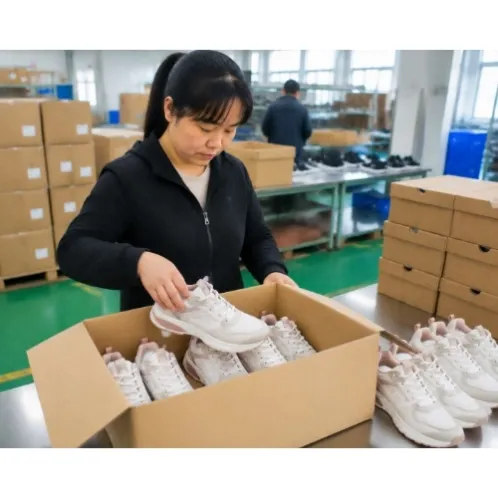
G&D provides independent Sample Picking and Witness Sampling services in China. Our inspector visits the factory or warehouse, selects samples according to your instructions, documents where and how they were selected, and arranges packing or dispatch as required.
This service is particularly useful when the origin and traceability of the sample matter, such as samples intended for laboratory testing, buyer approval, complaint investigation or comparison with actual production.
Starting from USD 160 per man-day.
When Should You Use a Sample Picking Service?
Independent sample picking can be useful when:
- Samples are required for laboratory testing.
- You need samples from actual mass production rather than supplier-prepared samples.
- A buyer or customer requires production samples for review or approval.
- You want to compare actual production with an approved or reference sample.
- A quality complaint needs further investigation.
- You are working with a new supplier or placing a first order.
- Samples must come from a specific production batch, lot or shipment.
- You need an independent party to witness and document the sample-selection process.
- Sample origin and traceability are important to your quality-control process.
The sampling method should be agreed before the visit so the inspector knows what products, quantities and production sources should be selected.
Where Can Samples Be Picked From?
Depending on the production status and your requirements, samples may be selected from:
Production Line
Samples can be selected from products available during ongoing production when you need to review or test current production.
Finished Production
Samples can be selected from completed goods to provide a clearer connection with the finished production batch.
Warehouse Stock
When finished goods have already been transferred to the factory warehouse, samples can be selected from available warehouse stock.
Packed Cartons
Where appropriate, the inspector can select samples from specified or randomly selected cartons according to the agreed instructions.
Specific Production Lot or Batch
If the factory uses identifiable lot, batch or production references, the inspector can select samples from the specified source where it is available and identifiable.
Specific Shipment Batch
For orders being prepared for shipment, samples can be selected from goods identified as belonging to the relevant shipment, subject to what can be verified on site.
The report documents the source that was available and observable during the visit.
What We Record During Sample Picking
The purpose of independent sample picking is not only to obtain the physical sample, but also to document the selection process and available identifying information.
Depending on the assignment, our inspector may record:
- Product name or item number
- SKU or model
- Quantity selected
- Sampling location
- Production status
- Batch or lot information where available
- Carton references
- Product labels
- Available production or shipment identification
- Photos of the products before and during selection
- Photos of selected samples
- Sample condition
- Packing condition
- Sample identification or marking
- Seal information where applicable
- Final packing
- Dispatch destination
The exact documentation depends on the product, factory conditions and sampling instructions.
Witness Sampling & Sample Traceability
In some situations, the most important question is not simply:
"Does this sample look good?"
It is:
"Where did this sample come from?"
Witness sampling provides independent observation of the sample-selection process.
Our inspector can attend the factory or warehouse, identify the available production or stock, select samples according to the agreed instructions and document the process with photos and available identifying information.
Where required and practical, selected samples can also be marked, packed or sealed after selection to help maintain identification between the factory visit and the next stage.
However, traceability depends on the information and physical identification available at the factory. An inspector cannot independently create batch traceability that does not exist in the supplier's production or inventory system.
For a more detailed explanation of sample origin and witness sampling, see Sample Picking in China: How to Verify Where Your Sample Came From.
How Our Sample Picking Service Works
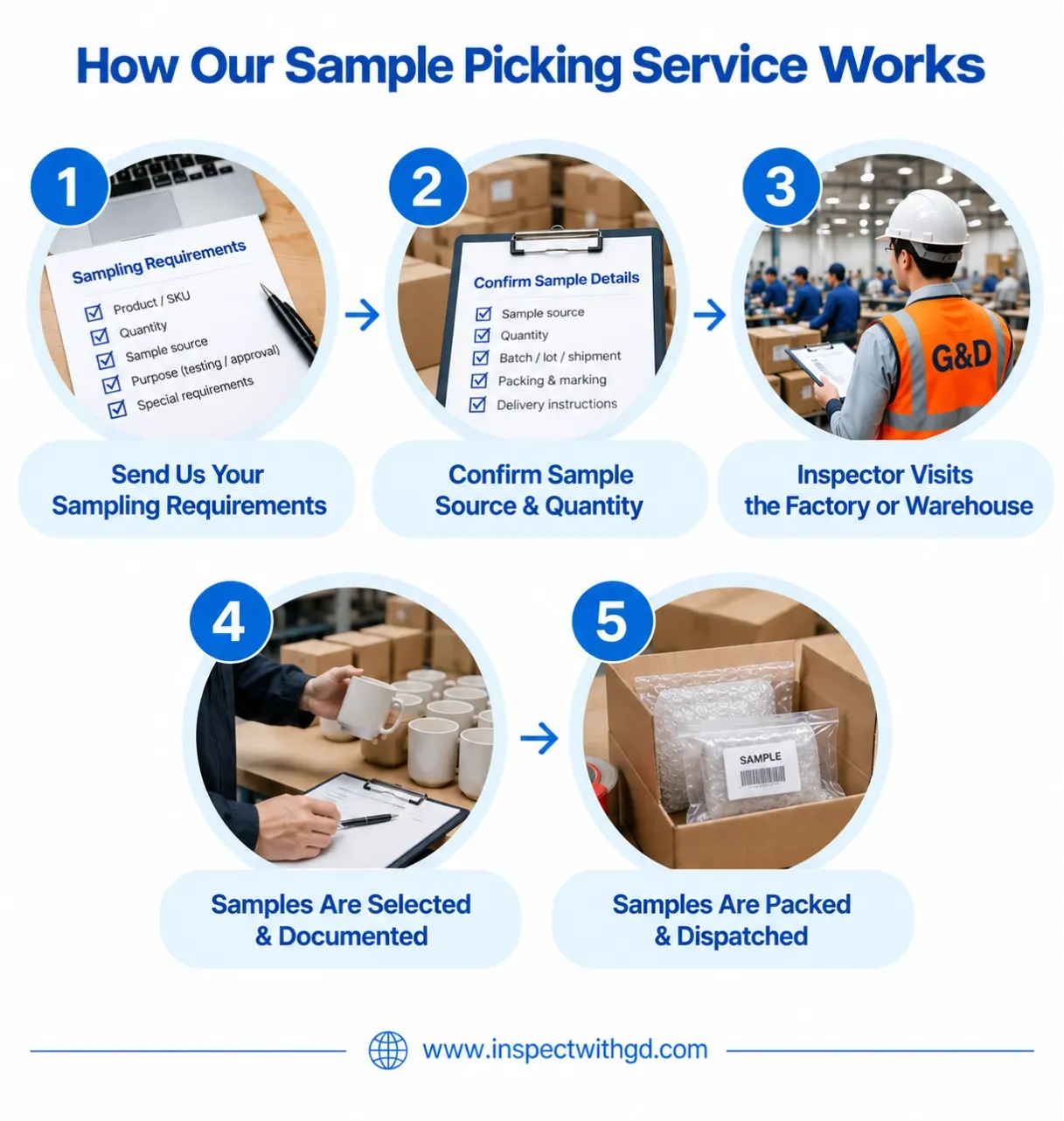
1. Send Us Your Sampling Requirements
Provide the product information, required sample quantity, sampling purpose, relevant batch or order information and any specific selection instructions.
2. We Confirm the Sample Source & Quantity
We confirm where the samples should be selected from, how many are required and any special requirements for identification, packing, sealing or dispatch.
3. Inspector Visits the Factory or Warehouse
Our inspector attends the agreed location and checks the products, production or stock available for sample selection.
4. Samples Are Selected & Documented
Samples are selected according to the agreed instructions. The inspector documents the selection process, sample source and available identifying information.
5. Samples Are Packed & Dispatched
Selected samples are identified and packed as agreed. They can then be prepared for dispatch to you, your customer, an appointed laboratory or another specified destination.
What Information Should You Provide Before Sample Picking?
To prepare the assignment, please provide as much relevant information as possible, including:
- Purchase order or order reference
- Product name
- SKU or model
- Product photos
- Required sample quantity
- Required sample source
- Batch, lot or shipment information where applicable
- Purpose of sampling
- Selection instructions
- Laboratory sampling requirements where applicable
- Required sample identification
- Sealing or marking requirements
- Packing instructions
- Delivery destination
- Courier information or account details where applicable
- Any special handling requirements
If the samples are intended for laboratory testing, please provide the laboratory's sampling quantity, size and packing requirements before the visit whenever possible.
Sample Picking for Laboratory Testing
Independent sample picking is often used before third-party laboratory testing.
The two services perform different functions:
Sample Picking answers:
Are the samples being sent for testing the samples we intended to select?
Laboratory Testing answers:
Do those samples meet the specified test requirements or standards?
G&D can independently select and document the samples and, where agreed, assist with preparing them for dispatch to the designated laboratory. Lab Testing Assistance can support the coordination of the testing process.
The laboratory remains responsible for conducting the test and issuing the laboratory test results.
Sample picking itself does not determine whether a product complies with a chemical, physical, safety or regulatory standard.
Sample Picking vs Supplier-Provided Samples
Supplier-provided samples are suitable for many normal sourcing situations, particularly during product development, quotation or initial sample approval.
However, there are situations where the buyer needs additional confidence about how the sample relates to actual production.
With a supplier-provided sample, the supplier normally chooses which unit to send.
With independent sample picking, an inspector selects the samples according to the buyer's agreed instructions from the production, finished goods, warehouse stock or other identifiable source available during the visit.
This provides additional documentation of the sample's origin and selection process.
It does not mean that every supplier-provided sample is unreliable. The appropriate method depends on why the sample is required and how important independent traceability is to the decision being made.
Sample Picking vs Product Inspection
Sample Picking and Product Inspection serve different purposes.
A Sample Picking Service focuses on independently selecting specific units and documenting where those samples came from.
A Product Inspection, such as a Final Random Inspection (FRI), evaluates a sample of the production batch against agreed quality requirements and records defects, measurements, function checks, packaging findings and other inspection results.
If your objective is to evaluate the overall finished order before shipment, FRI may be more appropriate.
If your objective is to obtain independently selected physical samples for testing, approval or further investigation, Sample Picking is the more relevant service.
In some cases, both services can be arranged as part of the same quality-control process.
What Will You Receive?
Depending on the assignment, you may receive documentation covering:
- Date and location of sample picking
- Product and order information
- Available production or stock observed
- Sample source
- Quantity selected
- SKU or model information
- Batch, lot or carton references where available
- Photos of the selection process
- Photos of selected samples
- Available labels or identification
- Sample marking or sealing information where applicable
- Packing photos
- Dispatch information where applicable
- Relevant observations or limitations
The purpose of this documentation is to provide a record of what the inspector observed and selected during the visit.
What Can and Cannot Be Verified?
Sample Picking Can Document
Depending on the agreed scope and what is available on site, our inspector can document:
- Where the samples were selected
- How the samples were selected
- Product/SKU information
- Quantity selected
- Observable batch, lot or carton references
- Product labels and available identification
- Sample condition
- Sample marking or sealing
- Packing
- Dispatch preparation
- Photos of the selection process
Sample Picking Cannot Guarantee
Independent sample picking cannot by itself guarantee:
- That the selected samples represent every unit in the production batch
- The overall quality level of the entire order
- Laboratory test results
- Product regulatory compliance
- Material composition
- Future production quality
- Information that cannot independently be verified on site
- Courier transit time
- Condition of the sample after it leaves the inspector's control
- Future changes to the production batch
If you need an assessment of the overall production batch, a product inspection may be required in addition to sample picking.
If you need chemical, physical, safety or regulatory testing, the selected samples should be submitted to an appropriate laboratory.
Sample Picking Service Cost in China
Starting from USD 160 per man-day.
The final cost depends on:
- Factory or warehouse location
- Number of products or SKUs
- Required sample quantities
- Complexity of the sampling instructions
- Time required on site
- Packing or sealing requirements
- Dispatch arrangements
Travel costs may apply when the factory or warehouse is outside our normal inspector coverage.
Courier charges, laboratory fees and other third-party costs are separate unless specifically included in the quotation.
We confirm the scope and cost before booking.
Frequently Asked Questions
What is a Sample Picking Service?
A Sample Picking Service uses an independent inspector to select physical product samples from a factory, production batch, finished goods or warehouse stock according to agreed instructions.
The inspector documents the sample source and selection process so the buyer has additional information about where the sample came from.
What is Witness Sampling?
Witness Sampling means an independent inspector attends and observes or performs the sample-selection process and documents relevant information about the sample source and selection.
The exact process depends on the product, production situation and buyer's requirements.
Can you pick samples from actual mass production?
Yes, provided the relevant production or finished goods are available and identifiable during the visit.
The required source should be specified before the assignment.
Can you select samples for laboratory testing?
Yes. Samples can be selected for dispatch to a laboratory.
If the laboratory has specific requirements regarding quantity, dimensions, packaging, sealing or identification, these should be provided before the factory visit.
Can you send the samples directly to a laboratory?
Yes, this can be arranged depending on the destination and courier requirements.
Courier charges and laboratory testing fees are separate unless otherwise agreed.
Can you seal the samples after picking?
Where required and practical, samples can be identified, packed or sealed after selection according to the agreed instructions.
The required method should be confirmed before the visit.
Does Sample Picking guarantee that the samples represent the whole production batch?
No. Independent selection provides additional confidence about the sample source and selection process, but a limited number of samples cannot guarantee the condition of every unit in a production batch.
For broader batch-quality evaluation, a product inspection such as FRI may be more appropriate.
Is Sample Picking the same as product inspection?
No.
Sample Picking focuses on selecting and documenting physical samples.
Product Inspection evaluates selected products against defined quality requirements and reports inspection findings.
How much does Sample Picking cost in China?
Our Sample Picking Service starts from USD 160 per man-day.
Travel, courier or other third-party costs may apply depending on the assignment.
Need Independently Selected Samples from China?
When the origin of a sample matters, independent sample picking provides a documented connection between the physical sample and the production, stock or shipment available during the visit.
G&D can select and document samples at factories and warehouses in China for buyer review, laboratory testing, complaint investigation and other quality-control purposes.
Send us your product information, required sample quantity and sampling instructions to arrange a Sample Picking Service in China.