
Oct 21, 2026AQL & Quality Standards
AQL Sampling by Color and Size: Practical Inspection Guide
Learn how to distribute AQL inspection samples across different colors and sizes of one garment style, with practical examples and sampling limitations.
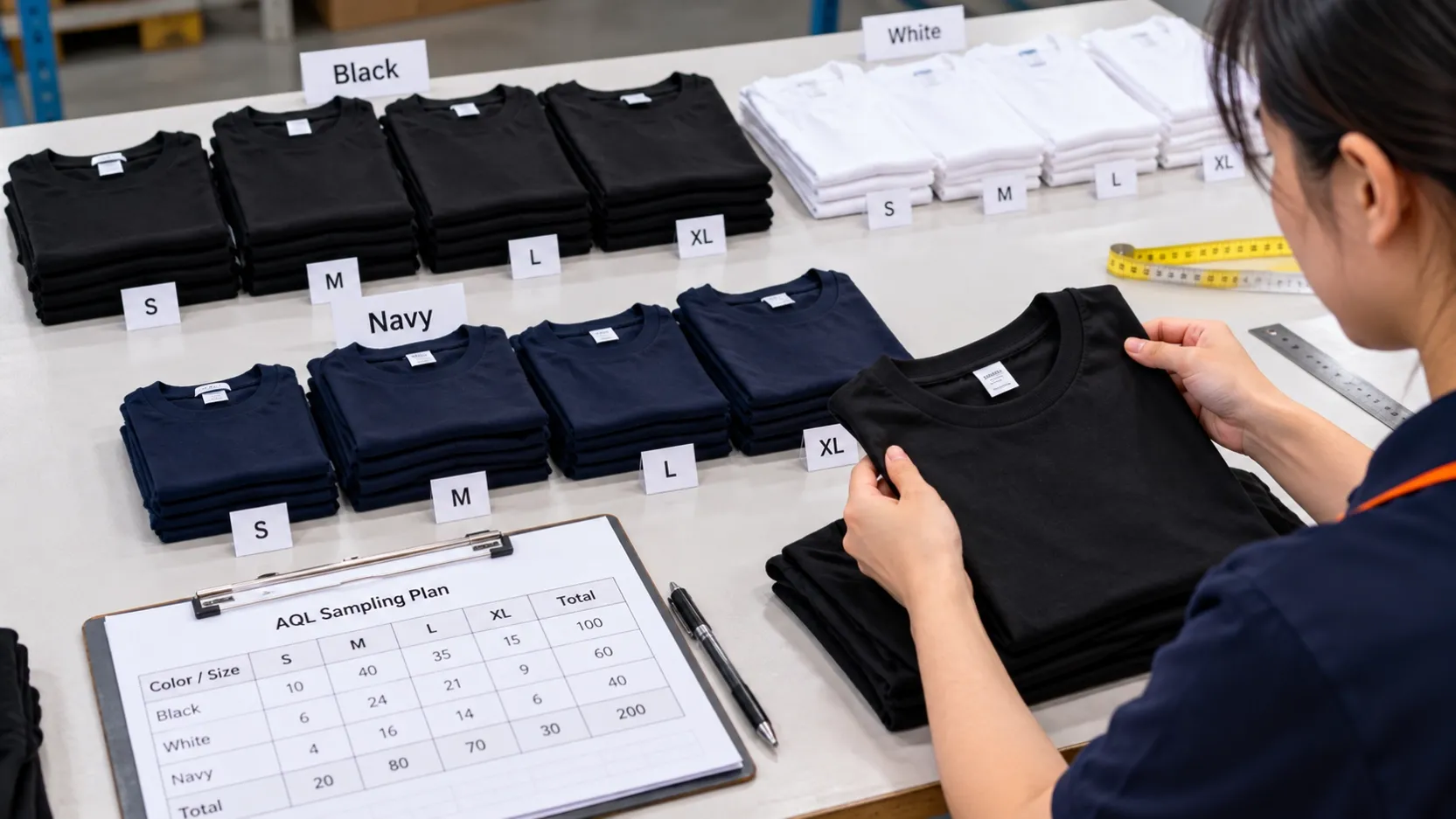
How to Distribute AQL Inspection Samples Across Colors and Sizes of One Style
Once the total inspection sample has been determined for one garment style, the next question is how to spread those pieces across its colors and sizes. A practical starting point is proportional allocation based on the actual order quantities. Small or higher-risk variants may then need deliberate coverage agreed before sampling begins.
The allocation still belongs to the defined inspection lot and sampling plan. A combined result for the style does not automatically give every color-size combination its own independent statistical acceptance result.
Begin With the Style, Then Confirm the Inspection Lot
Consider Men's Cotton T-Shirt TS001 in black, white and navy, with sizes S to XL. In our normal garment workflow, this is generally organized and reported as one style. The buyer's inventory system may assign a separate SKU to every color-size combination, but commercial SKU identification and inspection organization are not the same thing.
The statistical question must still be confirmed separately. One report per style does not prove that all variants form one suitable inspection lot. Different fabric lots, production lines, constructions or finishing processes may justify separate treatment. The agreed plan should define what the lot contains before the sample size and acceptance criteria are applied.
The current ISO 2859-1:2026 defines AQL-indexed sampling schemes for lot-by-lot inspection by attributes. ANSI/ASQ Z1.4-2003 (R2018) is the current edition listed by ASQ. Their public overviews explain acceptance sampling, but they do not provide a universal apparel formula for allocating samples among colors and sizes.
If the total quantity has not yet been established, How Many Pieces Are Inspected During a Quality Inspection? explains the preceding lot-size, inspection-level and sample-size steps.
Plan the Distribution Before Opening Cartons
The color-size spread should be prepared from the purchase order and packing breakdown, not adjusted after defects start appearing. A practical sequence is:
- Confirm the garment style and order quantity included in the scope.
- Review the quantity for every color-size combination.
- Confirm the defined inspection lot and agreed sampling plan.
- Determine the total sample size.
- Calculate an initial allocation across colors and sizes.
- Review small-volume and higher-risk variants before finalizing the spread.
- Select actual units using the agreed sampling approach and from relevant cartons.
- Perform the applicable workmanship, measurement, appearance, labeling and packing checks.
- Record every defect with its color and size.
- Apply Ac/Re rules at the level defined by the sampling plan.
- Report the actual sample breakdown and any limitations or deviations.
From our experience, the calculation is rarely the difficult part. The important step is making sure the factory's packing list shows where the required variants are packed so samples can be selected rather than presented by factory staff.
Worked Example: One Style, Three Colors and Four Sizes
Assume Style TS001 contains 4,000 T-shirts:
- Black: 2,000 pieces
- White: 1,200 pieces
- Navy: 800 pieces
- S: 400 pieces
- M: 1,600 pieces
- L: 1,400 pieces
- XL: 600 pieces
For this illustration only, assume the agreed total sample is 200 pieces. This is an input used to demonstrate the allocation arithmetic; it is not presented as the ISO- or ANSI-required sample size for this order.
The initial proportional allocation by color is Black 100, White 60 and Navy 40. By size, it is S 20, M 80, L 70 and XL 30.
Those two sets of totals do not reveal how many black XL or navy S pieces exist. A complete allocation requires the actual quantity for each color-size combination. The following order matrix is hypothetical and has been constructed so every total reconciles:
Color | S | M | L | XL | Total |
|---|---|---|---|---|---|
Black | 200 | 800 | 700 | 300 | 2,000 |
White | 120 | 480 | 420 | 180 | 1,200 |
Navy | 80 | 320 | 280 | 120 | 800 |
Total | 400 | 1,600 | 1,400 | 600 | 4,000 |
In this particular matrix, each cell can be allocated at five percent without rounding:
Color | S | M | L | XL | Sample Total |
|---|---|---|---|---|---|
Black | 10 | 40 | 35 | 15 | 100 |
White | 6 | 24 | 21 | 9 | 60 |
Navy | 4 | 16 | 14 | 6 | 40 |
Sample Total | 20 | 80 | 70 | 30 | 200 |
Real orders are usually less tidy. Decimal results must be rounded while keeping the final sample at 200. Any adjustment for minimum variant coverage or a known risk should be made before units are selected and recorded in the inspection plan.
Consider another 1,000-piece style with an agreed 50-piece sample. Six color-size combinations contain 451, 274, 158, 82, 30 and 5 pieces, producing proportional results of 22.55, 13.70, 7.90, 4.10, 1.50 and 0.25. One possible rounded allocation is 23, 14, 8, 4, 1 and 0, preserving the total of 50 but leaving the five-piece combination unchecked. This illustrative method is not a universal ISO or ANSI rule.
When a Small Variant Needs Deliberate Coverage
Pure proportional allocation can leave a low-volume combination with less than one sampled piece. That may be mathematically consistent but operationally unhelpful if the variant uses a special print, trim, fabric, wash or packing method.
If coverage of that combination is built into the originally agreed acceptance-sampling plan before selection, it forms part of the defined sample and is evaluated under the agreed Ac/Re rules. Any reallocation must be planned and technically justified; arbitrary changes do not necessarily preserve the statistical properties of the original plan.
Additional targeted inspection can instead be reported outside the acceptance sample. Its findings should not be merged into the original defect count or judged with the original Ac/Re numbers. They can inform a commercial decision or follow-up action. A separate variant pass/fail result requires a suitable plan and criteria agreed in advance.
Different Checks Need Different Variant Coverage
Distributing the workmanship sample does not mean every check must use the same 200 garments.
Check | Practical variant coverage |
|---|---|
Workmanship | Spread the main sample across the color-size matrix and record sewing, stains, fabric damage, print or embroidery defects, and trim problems against the affected variant. |
Measurements | Use each garment's approved size specification and tolerance. A result on size M does not verify size XL; the agreed measurement sample should cover the sizes needed to assess grading. |
Color and appearance | Compare relevant colors with approved references and sampled pieces with one another. Checking black does not verify shade, fabric appearance or decoration on white and navy. |
Labels and packaging | Match size labels, color identification, hangtags and barcodes to the physical garment, then check packing ratios and carton assortments against the order. |
Measurements, function checks and other time-consuming checks may use separately agreed quantities. AQL Special Inspection Levels S1-S4 Explained explains why smaller samples may be used for particular checks and why no special level has a universal test assignment.
The required method, quantity, variant coverage and acceptance criteria should appear in the product inspection checklist before the visit.
Apply the Acceptance Decision at the Correct Level
Color-size allocation tells the inspector where the selected pieces come from. It does not create a new AQL plan for every row or cell.
If the 200-piece sample represents one defined lot, its defect counts are compared with the Ac/Re criteria agreed for that lot. The combined sample's Ac/Re numbers must not be applied separately to black, white, navy or each size.
If the buyer needs an independent pass/fail decision for a particular color or size, the sampling plan must be designed to support that decision. Separate lots or separately defined acceptance plans may require more samples and inspection time.
Concentrated defects still matter. If most findings occur in navy XL, the report should identify that pattern even when the overall lot result remains within the agreed limit. AQL is an acceptance-sampling tool, not a guarantee that the shipment contains no defects or that each variant has the same defect rate.
What the Report Should Make Visible
A useful garment report identifies the style number and description, defined inspection lot and quantity, order breakdown by color and size, sampling plan and applicable standard, total sample, and actual color-size sample breakdown. It should also connect defects to their variants, show measurement results by sampled size, identify color-specific findings, record label and packing results, state the acceptance decision at the correct lot level, and disclose extra coverage or deviations.
A statement such as “200 pieces inspected - PASS” may therefore be insufficient on its own. The buyer also needs to see which 200 pieces were represented and at what level the acceptance decision was made.
Common allocation errors include drawing most pieces from the largest color, measuring only size M, overlooking small combinations, assuming one color represents the others, treating every color-size cell as an independent AQL plan, or changing the allocation after seeing results without documenting why.
Different Garment Styles Remain a Separate Question
A men's T-shirt and a women's T-shirt are normally organized as separate styles and reports in our workflow, even when they appear on the same purchase order. Combining different styles because quantities are small or the inspection budget is limited requires a separately agreed scope, sampling method, reporting structure and acceptance rule. It is not the color-size allocation discussed here.
Frequently Asked Questions
How are AQL inspection samples distributed across garment colors and sizes?
After the total sample is determined for the defined lot, the order's color-size matrix can be used for an initial proportional allocation. Small or higher-risk variants may receive deliberate coverage agreed and documented before selection.
Should every color receive the same number of samples?
Not automatically. Equal allocation can overrepresent small colors and underrepresent large ones. Order quantity is a practical starting point, while color-specific materials or processes may justify an adjustment.
Should every garment size be measured during inspection?
That depends on the agreed measurement plan. One size cannot verify another size's dimensions, so coverage should match the sizes and grading risks the buyer needs checked.
Can inspectors use proportional sampling by color and size?
Yes, proportional allocation is a practical method when the color-size quantities are known. It is not a universal ISO rule, and rounding or risk-based adjustments should be documented.
What if one color or size has a very small quantity?
The buyer can request deliberate or additional coverage where proportional allocation would provide too little information. The report should explain how that coverage relates to the main sample and acceptance decision.
Does one AQL result mean every color and size passed separately?
No. A combined result applies at the defined lot level. Independent conclusions for individual variants require a sampling plan designed to support those separate decisions.
Are different colors and sizes considered separate SKUs?
They may be separate commercial SKUs in the buyer's system. That does not automatically make them separate inspection styles or separate statistical lots.
Should different garment styles be inspected separately?
Normally, yes. If different styles are combined under a special commercial arrangement, the scope, allocation, reporting and acceptance rules must be agreed specifically.
Confirm the Color-Size Matrix Before Inspection
Before arranging a Final Random Inspection, provide the latest order and packing breakdown by style, color and size. Once the sample has been selected, finding that a small variant was omitted is much harder to correct without changing the agreed plan.