
Oct 5, 2026Quality Inspection Guides
AQL Special Inspection Levels S1-S4 Explained | G&D
Learn why measurements and function tests may use smaller samples than workmanship checks, and how AQL Special Inspection Levels S-1 to S-4 work.
AQL Special Inspection Levels S1-S4: Why Some Tests Use Smaller Sample Sizes
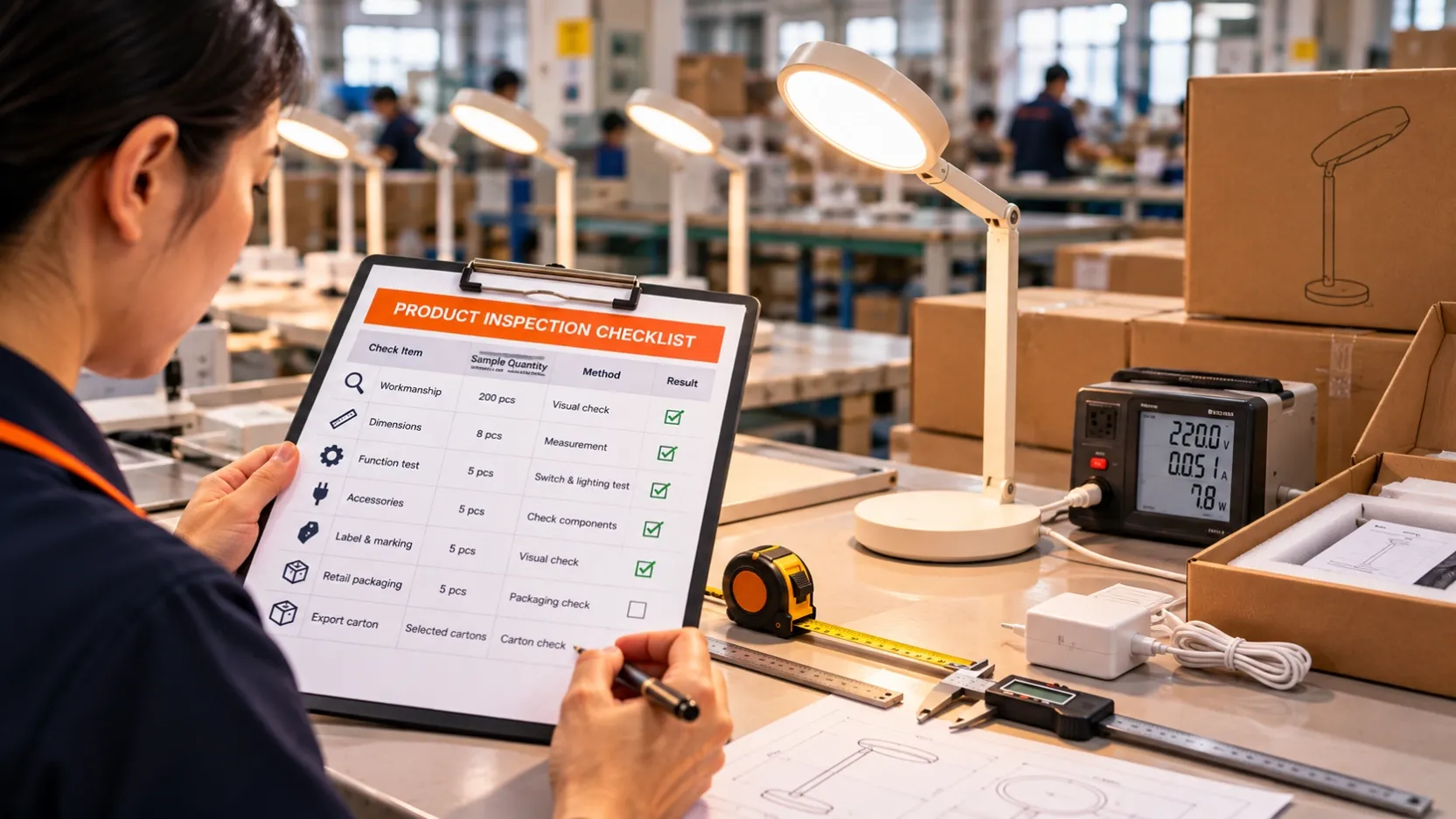
An inspection report may show that 200 pieces were checked for workmanship, while only eight were measured, five received a function test, and three went through a product-specific test.
This often leads to one question: if the main AQL sample is 200 pieces, why were the other checks performed on fewer units?
Some tests use fewer samples because they require more time, special equipment, repeated operation, product disassembly, or destruction. Different checks can therefore follow different agreed sampling scopes. Special Inspection Levels S-1 to S-4 provide smaller sample-size options when smaller samples are necessary and the resulting higher sampling risk can be tolerated.
This means one inspection can legitimately contain several sample quantities. The important point is that the method, quantity, acceptance criteria, and limitations of each check are confirmed before the inspection.
Why Can One Inspection Have Different Sample Sizes?
The main workmanship check normally covers a relatively broad sample because the inspector can examine appearance, assembly, materials, accessories, labels, and visible defects efficiently.
Other checks may take considerably longer.
Measuring finished dimensions may require positioning each product correctly and recording several values. A zipper cycling check requires repeated operation. A strap load test needs suitable equipment and preparation. A destructive check may make the tested unit unsuitable for sale.
Applying every time-consuming or destructive check to the full workmanship sample may be impractical. The inspection plan can therefore assign a separate quantity to each check according to its purpose and risk.
This does not mean the smaller checks are optional or less important. It means their sampling scope has been defined separately.
What Are AQL Special Inspection Levels S-1, S-2, S-3 and S-4?
Special Inspection Levels S-1, S-2, S-3, and S-4 are smaller-sample options used within applicable acceptance-sampling systems. They may be selected when checking a larger sample would require disproportionate time, cost, or product consumption, and when the buyer accepts the greater uncertainty associated with a smaller sample.
The current ISO 2859-1:2026 standard defines AQL-indexed acceptance-sampling schemes for inspection by attributes. It replaced ISO 2859-1:1999 in January 2026.
ANSI/ASQ Z1.4 provides a related acceptance-sampling system for inspection by attributes, including normal, tightened, and reduced plans.
Neither standard creates a universal rule that S-1 must be used for one type of test and S-4 for another. The appropriate level depends on the characteristic being checked, the test method, the available inspection time, the consequence of failure, and the sampling risk the buyer is prepared to accept.
General Inspection Levels vs Special Inspection Levels
General Inspection Levels I, II, and III and Special Inspection Levels S-1 to S-4 serve different sampling needs.
Inspection Level Group | Relative Sample Size | Typical Purpose | Important Limitation |
|---|---|---|---|
General Level I | Smaller than Level II | Reduced inspection effort where appropriate | Provides less information than a larger general-level sample |
General Level II | Medium general-level sample | Frequently used for routine third-party product inspection | Common practice, but not universally mandatory |
General Level III | Larger than Level II | More extensive sampling where additional information is required | Requires more inspection time |
Special Levels S-1 to S-4 | Generally smaller than general levels | Characteristics where a smaller sample is necessary or justified | Greater sampling uncertainty must be accepted |
General Level II is frequently used for workmanship inspection, but it is not automatically correct for every shipment.
Within the special levels, S-1 generally leads to the smallest sample, while S-4 generally leads to a larger sample for the same lot size. The exact result must still be taken from the applicable current sampling tables.
AQL Is Not the Same as Inspection Level
Buyers sometimes use the word “AQL” to describe the entire sampling process. Technically, AQL and Inspection Level perform different functions.
The basic sequence is:
Lot size + Inspection Level
→ applicable sample-size code letter
Code letter + applicable sampling table
→ sample size
Selected AQL + applicable sample size and sampling plan
→ acceptance and rejection criteria
The Inspection Level controls the relative amount of inspection. The selected AQL is then used with the applicable sample size and sampling plan to determine the acceptance and rejection numbers.
AQL alone does not determine how many pieces are checked, and it does not determine the Ac/Re numbers without the rest of the sampling plan.
Full ISO and ANSI/ASQ tables also contain rules that may direct the user to another sampling plan. For this reason, the current complete standard should be used when calculating an actual inspection plan.
For a step-by-step explanation of lot size, code letters, sample sizes, and acceptance numbers, see How Many Pieces Are Inspected During a Quality Inspection? A Simple Guide to AQL Sampling Plans.
Why Some Checks Use Smaller Sample Sizes
Different checks place different demands on the inspector, the factory, and the product.
Check Type | Why the Sample May Differ | Possible Sampling Basis | Main Limitation |
|---|---|---|---|
Workmanship | Many visible characteristics can be checked efficiently | Agreed general inspection level | Does not confirm every performance requirement |
Measurements | Each unit may require positioning and several recorded values | Agreed special level or fixed quantity | A smaller sample gives less information about size variation |
Basic function | Operation may take additional time or setup | Agreed special level or specified quantity | Tested units do not represent every unit with certainty |
Repeated-cycle test | Each unit must be operated multiple times | Buyer-defined quantity or agreed special level | Limited cycles may not represent long-term use |
Load or strength test | Equipment, setup, and test time may be required | Agreed test quantity or product standard | May damage or deform the sample |
Destructive test | Tested products may no longer be saleable | Specified quantity or separate test plan | Only a limited number of units may reasonably be consumed |
Packaging test | Cartons must be selected, measured, handled, or damaged | Agreed carton sample | Results apply to the tested cartons and conditions |
There is no universal quantity for any of these checks. Measurements are not always performed on five pieces, and packaging tests are not always performed on one carton. The appropriate quantity must be defined for the actual product and order.
S-1 vs S-2 vs S-3 vs S-4
The four Special Inspection Levels provide a progression of sample-size options:
- S-1 generally produces the smallest sample.
- S-2 generally produces a larger sample than S-1.
- S-3 generally produces a larger sample than S-2.
- S-4 generally produces the largest sample among the four special levels.
The exact sample does not increase by a fixed number between each level. It depends on the lot size and the applicable sampling tables, and different levels can sometimes lead to the same code letter for a particular lot-size range.
Moving toward S-4 generally provides information from more units, but it also requires more inspection time. Moving toward S-1 reduces the number of units checked but increases sampling uncertainty.
The decision should therefore be based on the characteristic being checked, not on a fixed rule that assigns particular tests to particular special levels.
Does a Smaller Sample Mean the Check Is Less Important?
No. Sample quantity and requirement importance are different questions.
A load or strength test may be performed on a limited quantity because it is destructive, time-consuming, or requires specialized equipment. A simple visual workmanship check may be applied to a much larger number of units because each piece can be examined quickly without damage.
The smaller load-test sample may address the more serious product risk, even though fewer units are tested.
A smaller sample does, however, provide less information about the shipment. It creates greater uncertainty about whether the tested result is consistent across the full lot. That limitation should be considered when the quantity is agreed.
Do All Inspection Tests Use AQL?
Not every product-specific check uses AQL acceptance sampling.
Depending on the requirement, a check may use:
- Pass/fail criteria for every tested unit;
- A buyer-defined zero-failure requirement;
- A fixed test quantity;
- A product-standard sampling method;
- An independent laboratory method;
- A destructive-test plan;
- Another agreed sampling approach.
For example, workmanship defects may be counted and compared with agreed AQL acceptance and rejection numbers. A basic assembly check may instead require every selected unit to assemble successfully. A destructive strength test may use a specified number of samples with a minimum required result.
Passing the tested samples does not prove that the entire lot is defect-free. It shows only that the selected samples met the stated requirements under the agreed method and conditions.
This is why the inspection checklist should state what will be checked, how it will be checked, how many units will be checked, and what constitutes acceptance. How to Build a Product Inspection Checklist for a China Order explains how to organize these requirements before the inspection.
Example: Different Sample Sizes in One Product Inspection
Consider a hypothetical order of 10,000 backpacks.
The agreed general-level sampling plan produces a 200-piece workmanship sample. The buyer also wants measurements, zipper cycling, strap-load testing, barcode scanning, and a packed-carton test.
The inspection scope might be arranged as follows:
Check | Hypothetical Quantity | Reason for Separate Quantity |
|---|---|---|
Workmanship and appearance | 200 backpacks | Main visual sample under the agreed general-level plan |
Finished dimensions | 8 backpacks | Several measurements must be taken and recorded on each unit |
Zipper cycling | 5 backpacks per selected SKU | Repeated operation requires additional time |
Shoulder-strap load test | 3 backpacks per selected SKU | Equipment and setup are required, with possible sample damage |
Barcode scanning | 3 units per barcode | Each barcode must be checked against the relevant SKU |
Packed-carton test | Agreed number of selected cartons | The test consumes inspection time and may damage the carton |
These quantities are examples for illustration only. They are not universal requirements for backpack inspections.
The example shows why “200 pieces inspected” does not mean every check must be performed 200 times. One inspection can contain several agreed sample quantities, each connected to a different characteristic and method.
When Should a Buyer Consider a Larger Test Sample?
A larger quantity may be worth considering when:
- The product or supplier is new;
- A previous order failed the same check;
- Production has shown inconsistent results;
- Customer complaints involve the characteristic being tested;
- Failure would seriously affect normal product use;
- The shipment contains many SKUs;
- Goods were made on several production lines or in separate batches;
- Process variation is suspected.
Increasing the sample does not remove all sampling risk, but it provides information from more units. The benefit should be considered together with test duration, inspection cost, possible sample damage, and the consequence of an undetected failure.
Buyers are not limited to one standard quantity for every check. Can You Choose Your Own Inspection Sampling Quantity? explains how additional sampling can be agreed for specific risks.
What Should Be Defined Before the Inspection?
For each product-specific check, confirm:
- The name and purpose of the check;
- The test method;
- Required equipment or factory facilities;
- Sample quantity or sampling level;
- Allocation across SKUs, colors, sizes, production lines, or batches;
- Acceptance criteria;
- Whether the test damages or consumes samples;
- Required photographs, readings, or other evidence;
- What should be recorded if the test cannot be performed.
These details prevent the factory, inspector, and buyer from working with different assumptions on the inspection day.
Frequently Asked Questions
What does S-2 mean in AQL sampling?
S-2 is one of the four Special Inspection Levels. It provides a smaller-sample option when a reduced sample is justified and the resulting sampling risk is acceptable. It is not automatically the correct level for measurements, function tests, or any other specific check.
What is the difference between S-1 and S-4?
For the same lot size, S-1 generally leads to a smaller sample than S-4 under the applicable sampling tables. S-4 normally provides information from more units but requires more inspection effort.
Why are only a few pieces function-tested?
A function test may require setup, repeated operation, factory equipment, or significant time. The quantity may therefore be defined separately from the main workmanship sample. The report should make the tested quantity clear.
Does every test use the same AQL sample size?
No. Different characteristics may use different inspection levels, fixed quantities, pass/fail requirements, laboratory methods, or other agreed sampling approaches.
Can I request more samples for a function test?
Yes. Additional samples can be agreed before the inspection when the product risk justifies them. The required time, equipment, SKU allocation, and acceptance criteria should also be confirmed.
Does a smaller sample mean the test is unreliable?
Not automatically, but it does mean greater sampling uncertainty. A smaller sample provides information about fewer units, so it gives less evidence about consistency across the shipment than a larger sample.
What is the difference between General Level II and S-2?
For the same lot size, General Level II will typically lead to a larger sample than Special Level S-2 under the applicable sampling tables. Level II is frequently used for broader workmanship checking, while S-2 is a smaller-sample option that must be justified for the particular characteristic and accepted sampling risk.
Who decides which Special Inspection Level to use?
The level should be agreed as part of the inspection plan. The decision should consider the product risk, test method, inspection time, cost, possible sample damage, and the consequence of failing to detect a problem.
Confirm Different Test Quantities Before Booking
If your inspection requires different quantities for workmanship, measurements, function checks, or product-specific tests, provide those requirements before booking a Final Random Inspection.
Confirming the sampling basis, method, acceptance criteria, and SKU allocation in advance makes the final report easier to understand and use.