Aug 15, 2026Quality Inspection Guides
Do You Really Need a Third-Party Inspection Company in China?
Do you need a third-party inspection company for every China order? Learn when independent inspection is worth considering, when it may be unnecessary, and how to judge the risk.
Do You Really Need a Third-Party Inspection Company in China?
A practical way to judge the risk of one particular order
Your supplier says the order will be ready next week. You have already paid the deposit, and before releasing the balance you receive a quotation for third-party inspection. Now there is another cost to consider: do you really need to inspect this order?
That is a reasonable question. Independent inspection can provide useful evidence before shipment, but inspecting every order is not automatically necessary. The better question is how much uncertainty this particular order carries, what could happen if something is wrong, and what quality-control resources you already have.
Inspection Is a Risk-Control Tool, Not a Guarantee
Depending on the agreed scope, an independent inspection can provide on-site evidence about workmanship, quantity, dimensions, function, packaging, labels, agreed specifications, visible defects, and shipment readiness. It gives the buyer information from the finished goods or production stage before the goods leave the factory.
It cannot guarantee zero defects in the entire shipment, future supplier performance, no customer complaints, no transport damage, perfect consistency in every unit, or commercial success. Hidden defects outside the scope may remain. Inspection reduces an information gap; it does not remove all risk.
For a finished-order check, see Final Random Inspection (FRI) Service. The service page is included here only as a reference for this type of inspection, not as a recommendation for every order.
Start With the Supplier: New Relationship or Proven History?
A first order with a new supplier usually gives you less historical evidence than the twentieth repeat order from a stable supplier. That does not make inspection mandatory. It means there are fewer past results to support the decision.
Consider whether you have previously received acceptable shipments, whether the factory has produced this exact product for you, whether specifications or materials have changed, whether production has moved to another facility, and whether previous checks found recurring problems. Supplier history is useful evidence, but it should be considered together with the current order.
Is This a New Product or a Stable Repeat Product?
Supplier familiarity and product familiarity are separate questions. A factory may have produced the same canvas bag for three years with the same fabric, dimensions, packaging, and construction. A new bag with a different material, finish, component, label, or function introduces more variables even when the supplier is familiar.
The more the current product differs from what the factory has produced successfully before, the less useful it is to rely only on past shipment history.
When a new product needs an independent check before mass production begins, Pre-Production Sample Review Service is a separate option to consider.
How Much Is the Order Worth, and What Happens If It Goes Wrong?
Order value is only one part of the decision. A USD 10,000 order may be relatively easy to correct in one business and commercially sensitive in another. Possible consequences include rework, replacement, repacking, relabeling, delayed launch, airfreight for replacement goods, retailer chargebacks, missed promotion dates, local repair, or disposal.
The practical comparison is not simply the order value against the inspection fee. Consider the consequence of discovering the problem after arrival against the cost of obtaining more information before shipment. An inspection may identify certain issues early, giving the buyer more options. It does not automatically prevent every consequence.
How Difficult Would the Problem Be to Fix After Arrival?
Imagine a simple, low-value promotional item. If a small number has a minor cosmetic issue, the buyer may be able to absorb or correct it locally. That may reduce the value of checking every order.
Now compare a large retail order with custom packaging, retailer labels, strict dimensions, and a fixed launch date. Local rework may be difficult or impossible, and the same defect rate could have a very different commercial effect. The harder a problem is to correct after import, the more valuable pre-shipment information may become.
How Easy Is the Product to Check?
Some products can be checked relatively efficiently for dimensions, appearance, basic function, packaging, and labeling. Others involve multiple components, electrical functions, performance requirements, safety-related characteristics, or laboratory requirements.
A normal product inspection does not replace laboratory testing, certification, or engineering validation where those are required. If performance cannot be confirmed through a reasonable on-site check, independent laboratory support may be more appropriate for that requirement. The inspection scope should match what can actually be observed and verified.
Do You Already Have Someone You Trust on the Ground?
Third-party inspection is one way to obtain independent information from the factory. It is not the only possible quality-control structure. You may already have a China office, internal QC employees, sourcing staff who visit factories, an established local representative, or another qualified person who can perform the required checks.
If those resources are suitable for the order and follow a clear procedure, hiring another third-party company may add limited value for some shipments. Internal QC and third-party inspection are not identical, but the decision should account for the quality-control coverage you already have.
Is the Supplier’s Own QC Enough?
Supplier QC is important, and a competent factory should have its own quality-control process. Third-party inspection should not be presented as a replacement for factory QC.
The roles are different. Factory QC mainly checks production as part of the manufacturing process. Buyer-side independent inspection provides evidence to the buyer based on an agreed scope. The inspector observes, the report records, and the customer decides what action to take.
When Independent Inspection Is Usually Worth Considering
Independent inspection may be worth considering when one or more of these conditions apply:
This is a first order with a new supplier, so there is limited shipment history to rely on.
The product, material, component, finish, packaging, or labeling has changed.
The order is commercially important, has a tight delivery deadline, or supports a retail launch.
The goods are expensive or difficult to repair, rework, or replace after arrival.
There are multiple SKUs with different requirements, or custom packaging must match a confirmed design.
Previous shipments or inspections found recurring problems that have not been fully understood.
You have no suitable person locally to check the finished goods before shipment.
The final balance is due before shipment and you want independent evidence about the completed order.
None of these points creates an automatic rule. They indicate that independent information may have greater practical value for this order.
When You May Not Need Third-Party Inspection for Every Order
A buyer may reasonably decide not to inspect every shipment when the supplier relationship is long-term, the same product has been produced repeatedly, specifications are stable, quality performance has been consistent, the order value and consequences are limited, and the buyer already has effective local QC coverage.
Other reasonable approaches include periodic inspections, checking selected orders, inspecting after a product or specification change, or arranging a check after a quality problem. There is no universal rule such as inspecting every third order. The right frequency depends on the pattern of risk and the information already available.
Should You Inspect Every Repeat Order?
Not necessarily. A passed shipment is evidence about that shipment, not proof that the next production run will be identical. Raw material batches, workers, production lines, subcontractors, packaging suppliers, production schedules, machine settings, and component suppliers can change.
A buyer may choose to inspect every order, inspect periodically, inspect only higher-risk orders, or inspect after a change or problem. That is a risk-management decision rather than a fixed industry schedule.
When the concern is an issue developing before production is complete, During Production Check (DPC) Service may be the more relevant service to review.
Factory Audit and Product Inspection Answer Different Questions
A factory audit primarily helps assess a supplier or factory and its capability or processes. Product inspection primarily checks a particular order against agreed requirements. If your question is whether a supplier is capable of producing your product, a factory audit may be relevant. If your question is whether the finished order meets your requirements before shipment, product inspection may be relevant.
Inspection Does Not Replace Clear Specifications
An inspector cannot reliably check “good quality” without knowing what you require. Useful inspection references may include specifications, dimensions, tolerances, an approved sample, packaging requirements, labeling, artwork, functional requirements, test instructions, and defect criteria where appropriate.
An inspector can check requirements; the inspector should not invent them. The clearer the reference, the more meaningful the findings will be. The report can record differences and evidence, but commercial decisions about acceptance, payment, rework, or shipment belong to the buyer unless another arrangement says otherwise.
A Simple Decision Framework
Before deciding, review five factors:
Supplier uncertainty: low, medium, or high.
Product or specification change: low, medium, or high.
Order value and commercial exposure: low, medium, or high.
Consequence of finding the problem after arrival: low, medium, or high.
Existing quality-control coverage: strong, moderate, or limited.
This is not a mathematical risk score. Do not create an artificial rule such as “if you score twelve points, inspect.” If most factors are low and your QC coverage is strong, third-party inspection may add limited value. If several factors are high and you have little independent visibility before shipment, inspection may be more useful.
A Practical Example: Two Orders, Two Different Decisions
Consider a buyer sourcing outdoor patio cushions. In Order A, the buyer has worked with the same supplier for four years. The product is a standard outdoor seat cushion with the same fabric, dimensions, filling, stitching, and packaging as previous shipments. It is a small repeat order, and the historical results have been stable. The buyer may reasonably choose not to purchase third-party inspection for every shipment and instead use periodic checks or inspect when something changes.
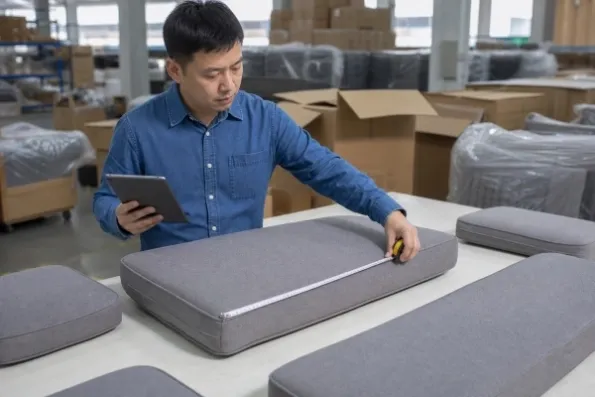
Order B is from the same buyer and the same supplier, but it is a new product: large outdoor bench cushions. The dimensions, fabric, zipper construction, vacuum packaging, carton size, and retail launch date are all different. The supplier is familiar, but the product and packaging risks have changed. Independent inspection before shipment may therefore provide more useful information.
The point is not that one order is safe and the other is unsafe. The point is that the same supplier does not create the same risk for every product.
How Much Should Inspection Cost Relative to the Order?
There is no universal rule that inspection should cost less than a fixed percentage of the order value. Consider the order value, complexity, possible consequences, information gained, and the QC resources already available.
If an inspection costs USD 160 per man-day, the useful question is not simply whether USD 160 feels expensive. Ask what additional information that inspection provides before you release or ship this particular order. The fee should be evaluated in the context of the decision, not treated as a universal indicator of whether inspection is worthwhile.
So, Do You Need an Inspection Company?
Sometimes yes. Sometimes no. Sometimes the answer is not for every order.
The decision depends on what you know, what you do not know, what has changed, what could happen if something is wrong, and what other QC resources you already have. The purpose of inspection is not to make every order risk-free. It is to give you additional evidence at a point when you may still be able to act on it.
How GD Inspection Can Help You Decide the Appropriate Scope
If you are unsure whether an order needs supplier verification, a factory audit, during-production inspection, pre-shipment or final random inspection, or container loading supervision, you can provide the product information, order quantity, supplier status, production stage, and main concerns.
GD Inspection can explain which available service may match those concerns. The purpose is to clarify the scope that fits the question you need to answer, not to suggest that every order requires the most extensive option.
If you are comparing providers after deciding that inspection is appropriate, see How to Compare Inspection Companies in China Before You Choose One. If this is your first cooperation with an unfamiliar provider, How to Verify an Inspection Company in China Before You Pay covers the verification questions separately.
Frequently Asked Questions
Do I need a third-party inspection for every order from China?
No. Frequency depends on supplier history, product stability, order risk, the consequences of a problem, and the quality-control resources you already have.
Is inspection more important for a new supplier?
It may be more valuable because you have less historical evidence about the supplier’s performance. It is not an automatic rule.
Should I inspect repeat orders?
Not necessarily every one. Periodic inspection or inspection after a product, packaging, supplier, or quality change may be appropriate.
Can I rely only on my supplier’s QC?
Factory QC is important, but buyer-side independent inspection serves a different role by providing evidence based on the agreed scope.
Is a passed inspection a guarantee that there will be no defects?
No. A passed report describes the sampled goods and agreed checks at a particular time. It does not guarantee zero defects or no later complaints.
Is third-party inspection worth the cost for a small order?
It depends on the consequences of a problem, not only the purchase value. A small order can still be commercially important, while another small repeat order may carry limited risk.
When should I book a pre-shipment inspection?
Arrange it when the goods are sufficiently complete for the agreed checks and before shipment. The timing should match the production schedule and the decision you need to make.