Aug 15, 2026Factory Audit & Supplier Verification
How to Verify an Inspection Company in China Before You Pay
Found an inspection company in China online? Learn practical checks to verify company details, contact information, payment instructions, sample reports, and service claims before you pay.
How to Verify an Inspection Company in China Before You Pay
A practical due-diligence guide for first-time cooperation
You search online for a third-party inspection company in China, exchange a few emails, receive a quotation, and then get payment instructions. Before sending the first payment or sharing your order details, one reasonable question remains: who are you actually dealing with?
No single certificate, review, website, or sample report can answer that question perfectly. A more useful approach is to compare several pieces of information: the company identity, contact details, quotation, invoice, payment beneficiary, service description, sample deliverables, and communication. The purpose is not to prove that a provider is “100% safe.” It is to identify inconsistencies while you still have time to clarify them.
Start With the Company’s Basic Identity
First establish who will provide the service and receive payment. Record the company or legal entity name, trading name, business address, website, email domain, telephone details where available, and the name shown on the quotation or invoice.
A brand name and a legal company name do not always match. A provider may operate under a trading name while the invoice uses the registered entity. That difference is not automatically a problem. Ask a direct question: “What is the legal entity providing the service and receiving payment?” The answer should explain the relationship in a way that matches the quotation and payment documents.
Check Whether the Contact and Payment Information Fit Together
Look at the whole chain rather than one isolated detail. A website may use one brand name, an employee may write from a company domain, the quotation may show the trading name, and the invoice may identify a related legal entity. The wording does not need to be identical, but the relationship should be understandable.
A company-domain email can support that consistency, but a Gmail or Outlook address alone does not prove fraud. The reverse is also true: a polished domain does not prove that the service will be reliable. Treat email, website, quotation, invoice, and beneficiary information as connected evidence.
Can the Company’s Registration Information Be Checked?
For a China-registered company, registration information may be checked through official Chinese corporate registration or publicity systems and other legitimate business-information sources. Depending on the source, you may be able to review the company name, registration status, registered address, legal representative, business scope, and registration details.
This check answers a limited question: whether an entity appears in the relevant registration system. It does not prove inspection quality, inspector competence, independence, future performance, or honesty in every transaction. Registration is useful context, not a complete service assessment.
Compare the Quotation, Invoice, and Payment Instructions
Before payment, compare the provider name, service description, factory location, inspection type, estimated man-days where applicable, confirmed date, quoted amount, payment instructions, and contact details. These documents do not have to follow one fixed format. They should, however, describe the same transaction.
If the information changes between the email, quotation, invoice, and payment instructions, ask what changed and why. Pay particular attention when the beneficiary, company name, or payment amount changes shortly before payment. A clear explanation supported by matching documents is different from an unexplained change.
Treat a Bank Beneficiary Change as a Verification Point
Payment instructions can be affected by email compromise, impersonation, incorrect forwarding, administrative mistakes, or account substitution. If you receive a message saying, “Please use our new bank account,” do not rely only on that unexpected message to confirm the change.
Use a previously established contact channel instead. Reply through a known company email thread, call a confirmed contact number, or independently ask the provider to verify the beneficiary. The question is not whether payment must always be made after the inspection. Advance payment can be a normal commercial policy. The important question is whether the person or entity receiving the money matches the provider you intended to hire, or whether the relationship has been properly explained.
Does the Bank Account Have to Match the Brand Name Exactly?
Not necessarily. A brand and legal entity may differ, international payments may use another legitimate group company, or a payment processor may be involved. Do not label the arrangement automatically. Ask the provider to explain the connection and check that the explanation is consistent with the invoice and payment documentation.
Ask for a Redacted Sample Inspection Report
A redacted report can show whether the provider’s normal deliverable contains the information you need. Look for a clear inspection scope, sample quantity, defect findings, photographs, measurements, test observations where relevant, packing remarks, limitations, and a result or summary when applicable. You can also compare the report format with the practical points explained in How to Read a Pre-Shipment Inspection Report: A Practical Guide.
A weak sample report is a service-quality concern, not proof of fraud. It may mean that the reporting style does not suit your requirements or that you need to clarify the expected deliverable. A polished sample report should also be treated carefully: it shows what the provider can present as an example, not a guarantee of every future inspection.
Ask a Few Basic Process Questions
Before paying, ask what information the provider needs, how the factory is contacted, how the date is confirmed, what happens before the visit, what you receive afterward, and who handles questions about the report. Different companies may use different workflows, so the purpose is to understand the proposed process rather than demand one particular method.
For a closer look at the people and responsibilities behind an inspection, see [Inspection Team in China: Who Actually Handles Your Inspection?].
Use Online Reviews as Supporting Evidence
Google, Trustpilot, LinkedIn, industry discussions, and other legitimate platforms can provide context. They are not proof. A company with many reviews is not automatically reliable, while a small B2B provider may have few public reviews because customers do not post frequently or because commercial confidentiality limits what can be shared.
When direct references are unavailable, ask whether the provider can share anonymized case examples, redacted reports, published testimonials, or a description of similar work. An inspection company should not be expected to disclose private customer contact details without permission.
A Low Price Is a Question, Not a Verdict
There is no universal minimum legitimate inspection price. Costs vary with location, scope, travel, inspector availability, business model, and what is included. A low quotation may justify asking what the service covers, whether travel is included, how many products or samples are checked, and what the report contains. Price alone does not prove fraud, poor inspection, junior inspectors, or hidden charges.
For a fuller comparison of scope, pricing, and quotation terms, see How to Compare Inspection Companies in China Before You Choose One.
A Professional Website Helps, but It Is Not Proof
A website, company email, LinkedIn page, published article, or team profile can help you establish context. The more useful question is whether the information matches the company, communication, quotation, invoice, payment instructions, and service being offered. Consistency across several ordinary signals is more meaningful than an attractive website by itself.
Start With a Clearly Defined First Inspection
Online research cannot remove all uncertainty. A practical next step may be one clearly defined engagement: one order, one factory, clear product requirements, a stated inspection scope, and an agreed deliverable. This lets you observe the actual sequence from enquiry and requirements to quotation, factory coordination, inspection, report, and follow-up.
A successful first inspection does not guarantee every future inspection will be identical. It does give you service evidence that online claims cannot provide. Where appropriate, a Final Random Inspection can be used to verify a defined shipment before dispatch.
Fraud or Payment Risk Versus Service Quality
The following comparison helps keep different concerns separate. A weak website or slow response may affect your experience, but it is not the same as an unexplained payment change or a request to send funds to an unrelated personal account.
Signal | What It May Mean | What to Do |
|---|---|---|
Unexplained bank-account change | Possible payment or security concern | Verify it through a previously established contact channel before paying. |
Payment request to an unrelated personal account | The intended beneficiary is unclear | Ask who receives the funds and why; compare the answer with the invoice. |
Company name differs from brand | May be a legitimate legal-entity difference | Ask for the relationship and check the documents. |
Very low price | Commercial or scope difference | Confirm inclusions, exclusions, and total expected cost. |
Few online reviews | Limited public evidence | Use registration, consistency, reports, and communication as other signals. |
Basic website | Limited online presentation | Check whether the underlying company information is consistent. |
Weak sample report | Possible service-quality concern | Clarify reporting expectations or compare another provider. |
Slow email response | Possible communication issue | Decide whether the response speed meets the needs of your order. |
A Practical Verification Example
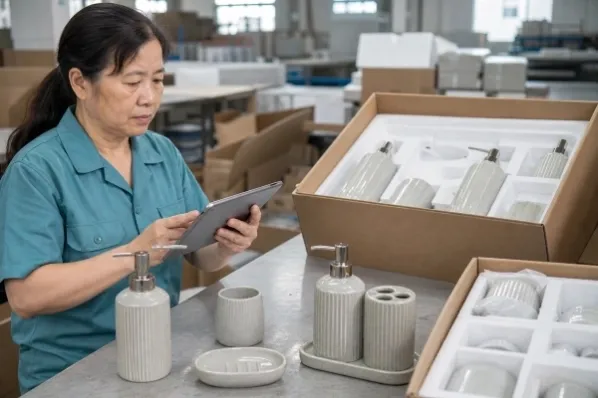
Imagine a Spanish company sourcing ceramic bathroom accessories such as soap dispensers, toothbrush holders, soap dishes, and matching sets. The company finds an unfamiliar inspection provider online and receives a website link, several emails, a quotation, an invoice, payment instructions, and a redacted sample report.
Before paying, the customer confirms the provider’s brand and legal entity, compares the website and email details with the quotation and invoice, reviews the beneficiary, reads the sample report, and asks how the inspection process works. None of these checks proves future performance, but together they reveal whether the basic information fits.
Shortly before payment, another email requests a different beneficiary. The customer does not immediately label the provider fraudulent. Instead, they contact the provider through the previously established channel and confirm whether the change is genuine. The practical sequence is simple: verify, clarify, and confirm before sending the money.
What Verification Cannot Guarantee
Even after reasonable checks, you cannot guarantee that every future inspection will be perfect, every inspector will make the same judgment, every report will contain zero errors, a registered company will always provide good service, online reviews are authentic, or a professional website reflects operational quality. Verification reduces uncertainty; it does not eliminate it.
How GD Inspection Makes First Cooperation Clear
For a first engagement, GD Inspection’s process starts with clear communication about the order, product requirements, inspection scope, quotation, and reporting. Before the inspection is arranged, we confirm what needs to be checked, where the goods are located, and what information the customer needs from the inspection.
The purpose of these steps is not to promise certainty. It is to make the service and deliverable understandable before the inspection begins, then provide on-site findings and follow-up communication after the visit.
Frequently Asked Questions
How can I check whether an inspection company in China is legitimate?
No single check proves it. Review the company identity, registration information where available, website and email consistency, quotation, invoice, payment beneficiary, sample report, and proposed process.
Does a China inspection company need a business license?
A China-registered business will normally have relevant registration information, but requirements can vary by business structure. Treat registration as evidence that an entity exists, not proof of inspection competence.
Is a cheap inspection company likely to be a scam?
No. Price alone does not establish fraud. Compare the scope, inclusions, travel arrangements, reporting, and total expected cost.
Should I pay an inspection company before the inspection?
Payment policies vary, and advance payment can be normal. Confirm the provider, invoice, beneficiary, amount, and service before payment.
Is it safe to pay if the bank account name differs from the website brand?
Not enough information to answer automatically. Brand and legal entity names may differ. Ask for the relationship and verify the payment information before sending funds.
Should I trust online reviews?
Use reviews as one signal, not proof. Compare them with company information, communication, documents, sample reports, and the clarity of the proposed service.
What should I do if the bank account suddenly changes?
Pause the payment and verify the new instructions through a previously established contact channel. Do not rely only on the message that announced the change.